

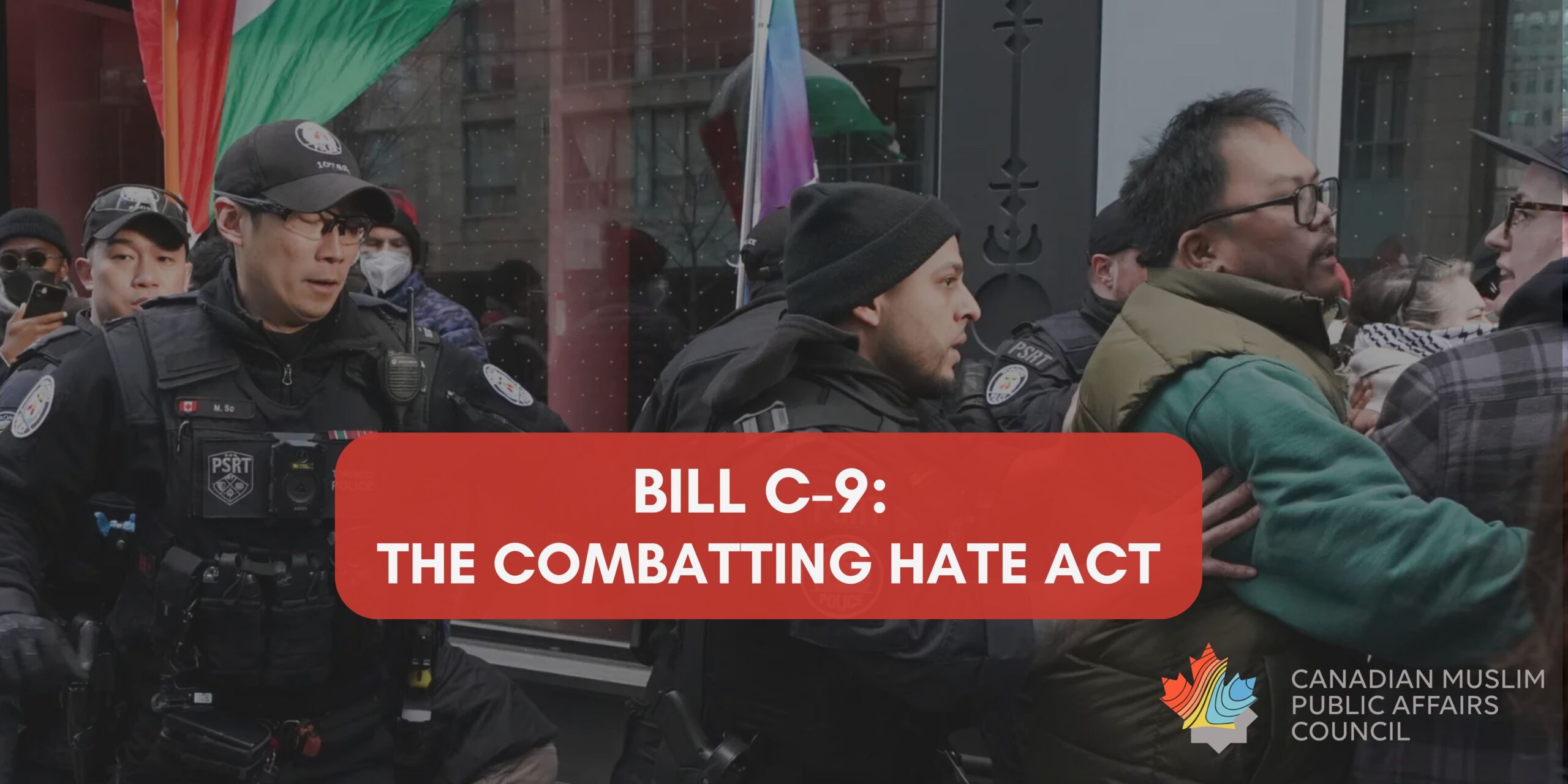
Monday October 6 – We, the undersigned Muslim and Palestinian civil society and community organizations, collectively reject Bill C-9 – An Act to amend the Criminal Code (hate propaganda, hate crime and access to religious or cultural places). While we firmly oppose all forms of hate, especially hatred directed at identifiable groups, we do not believe this bill offers any protections beyond what already exists in the Criminal Code. Instead, if passed, it could be used to restrict freedom of expression and weaponized against our community and other minority groups.
Muslim communities in Canada have historically experienced disproportionate policing, surveillance, and criminalization under laws intended to address national security and hate-related offenses. Broad statutory powers in these contexts have often been applied selectively, disproportionately affecting minority communities. In this context, Bill C-9 introduces a range of measures that have the potential to restrict constitutionally protected freedoms, including freedom of expression, freedom of assembly, and equality rights, without providing additional protection beyond existing criminal law. Of particular concern is the potential chilling effect on lawful political expression, including advocacy related to Palestine, student activism, and community organizing.
We endorse and support the joint open letter by the Canadian Civil Liberties Association’s (CCLA) and civil liberties organizations on Bill C-9, which conclude that the Bill is constitutionally overbroad, duplicative of existing criminal provisions, and open to selective enforcement. CCLA also highlights in their statement that the Bill risks criminalizing peaceful protest and certain forms of protected speech, two cornerstones of a free and democratic society, and could push activists into silence. The joint letter provides a clear framework for understanding how these provisions may affect fundamental rights and disproportionately impact specific communities.
From our perspective, two features of Bill C-9 are particularly significant:
- Removal of Attorney General oversight – By eliminating oversight and transferring broad prosecutorial discretion to police, the Bill increases the risk of selective enforcement and discretionary misuse, which has historically disproportionately affected minority communities.
- Expansion of “protected spaces” and restrictions on protest – The bill extends offenses to any building “primarily used” by an identifiable group, for non-religious functions, including sports and cultural activities. This expansion could create uncertainty around lawful assembly and protest, particularly in community and religious spaces, potentially restricting civic participation and political advocacy.
Additional provisions warranting attention include:
- Creation of a standalone “hate crime” category with enhanced penalties – Current criminal law already treats expressions of hatred as aggravating factors in sentencing. The introduction of a separate category with elevated penalties is legally redundant and increases the potential for disproportionate consequences for Muslim individuals.
- Criminalization of symbols associated with entities on Canada’s terrorist list, which risks conflating legitimate political expression with terrorism, particularly with respect to Palestinian, Kurdish, or other Muslim liberation movements.
- Vague definitions of “intimidation” and “obstruction”, which may result in subjective enforcement against lawful demonstrations or public expression.
Collectively, these provisions represent a significant expansion of prosecutorial and policing powers with little demonstrated benefit in preventing harm. Overbroad criminalization can produce disproportionate impacts on minority communities, undermine public trust in institutions, and limit meaningful participation in democratic processes.
In conclusion, while combating hate remains an important public policy objective, Bill C-9 introduces measures that are unnecessary, duplicative, and constitutionally problematic. Overbroad criminalization disproportionately affects minority communities, erodes public trust, and restricts civic participation. Accordingly, we call on Parliament to reject Bill C-9 in its entirety and to pursue community-centered approaches that protect vulnerable groups while safeguarding the constitutional rights and freedoms of all Canadians.
Signatories:
- Canadian Muslim Public Affairs Council (CMPAC)
- Canadian Muslim Lawyers Association
- Justice For All Canada
- Muslim Association of Canada
- Doctors for Humanity
- Hikma Public Affairs Council (London)
- Bel Agir (Quebec)
- AC Vote (GTA)
- Al Huda Institute Canada (GTA)
- Al-Salam Centre (Calgary)
- Barrhaven Islamic Centre (Ottawa)
- Canadian Institute of Islamic Civilization (Montreal)
- Canadians Supporting Refugees in Dire Need – CSRDN (GTA)
- Centre Communautaire de Quebec (Quebec)
- Centre Communautaire Laurentien (Montreal)
- Centre Communautaire Villeray (Montreal)
- Hespler Masjid (Cambridge)
- Ibrahim Jame Mosque (Hamilton)
- INSAF uOttawa (Ottawa)
- Islamic Centre – Hyde Park (London)
- Islamic Centre – Ottawa (Ottawa)
- Islamic Centre – Vancouver (Vancouver)
- Islamic Centre – Verdun (Montreal)
- Islamic Centre – Waterloo (Waterloo)
- Islamic Centre – Westmount (London)
- Islamic Centre (Edmonton)
- Islamic Centre Cold Lake (Cold Lake)
- Islamic Community Centre of Ontario (GTA)
- IslamicFamily (Edmonton)
- Jerusalem Community Services of Ontario (Ottawa)
- Kitchener Masjid (Kitchener)
- Masjid Aisha (Guelph)
- Masjid Toronto (GTA)
- Mission Relief (Ottawa)
- Muslim Association of Brantford (Brantford)
- Muslim Neighbour Nexus (GTA)
- Noor Gardens (London)
- Pakistan Canada Association (Vancouver)
- Palestine House-Toronto (GTA)
- Qurtuba Islamic Centre (Ottawa)
- Rose City Islamic Centre (Windsor)
- Tawheed Community Centre (GTA)
- Think for Actions (Calgary)