

By Khaled Alqazzaz
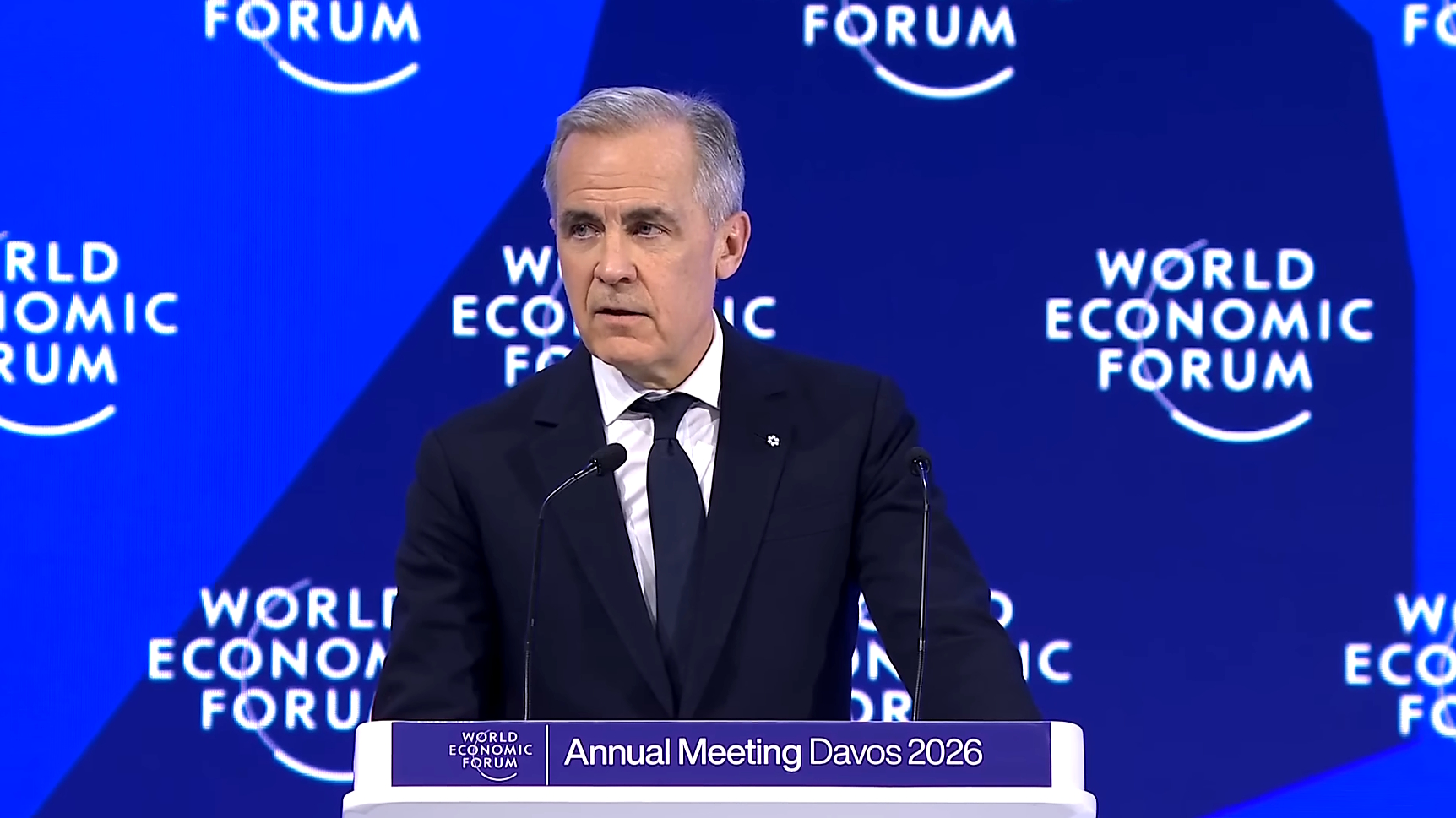
Prime Minister Mark Carney’s address at the World Economic Forum has gained international recognition and left a strong impression that Canada may be positioning itself for renewed global leadership. But the credibility of that leadership will depend on whether Canada is prepared to translate its rhetoric into concrete foreign policy choices.
Prime Minister Carney’s address at the World Economic Forum warned that the world is living through “a rupture, not a transition,” and that the “old world order is not coming back.” His critique of the “rules-based order” as having been applied discriminately and that the “strongest exempt themselves when convenient,” leaving “rules enforced asymmetrically…that international law is applied differently depending on the identity of the accused and the victim.” What Israel has done and continues to do to Palestinians in Gaza has exposed precisely this asymmetry.
In this sense Gaza is not a competing issue to Carney’s new framework, it is the perfect case study of the gap he described between international rhetoric and international reality. Carney warned against the strategic vulnerability of dependence, arguing that “a country that can’t feed itself, fuel itself, or defend itself has few options.” Yet Gaza represents the systematic production of unlivable conditions through Israel’s sustained military assault and restrictions on humanitarian relief that have collapsed basic life systems with the denial of food, water, safety, medical relief, shelter, defence, and freedom of movement.
Carney insisted that “middle powers like Canada are not powerless,” and that they can “build a new order” grounded in “respect for human rights… solidarity, sovereignty, and territorial integrity of states.” Arguing that this new approach should rest on “values-based realism” … principled in our commitment to fundamental values, “sovereignty and territorial integrity, the prohibition of the use of force except when consistent with the UN Charter, respect for human rights”
Prime Minister Carney cannot meaningfully present Canada as a builder of a new order while continuing “business as usual” economic and diplomatic cooperation that normalizes Israel’s repeated breaches of international law and entrenches impunity for a state that has gone rogue. Rather, it must mean a rupture from the alignments that have enabled the erosion of international law through selective enforcement including the blind eye extended to Israel’s war crimes in Gaza and across occupied Palestinian territory.
This new approach requires Canada to operationalize its legal and diplomatic commitments rather than treating them as aspirational language. This means aligning foreign policy tools including export controls, sanctions policy, multilateral voting behaviour, and bilateral agreements with Canada’s duties under international humanitarian and human-rights law. Where credible evidence indicates serious violations, consistency demands precautionary restrictions, support for international accountability processes, and cooperation with UN and international court mechanisms. International law not only prohibits direct violations but also cautions states against aiding, assisting, or normalizing unlawful situations. A principled foreign policy therefore requires Canada to ensure its economic, security, and diplomatic relationships do not contribute, directly or indirectly, to the maintenance of internationally wrongful acts
A foreign policy grounded in the UN Charter, human rights and territorial integrity must include concrete consequences: ending arms loopholes that sustain complicity and reconsidering economic cooperation that shields international law violations from accountability.