
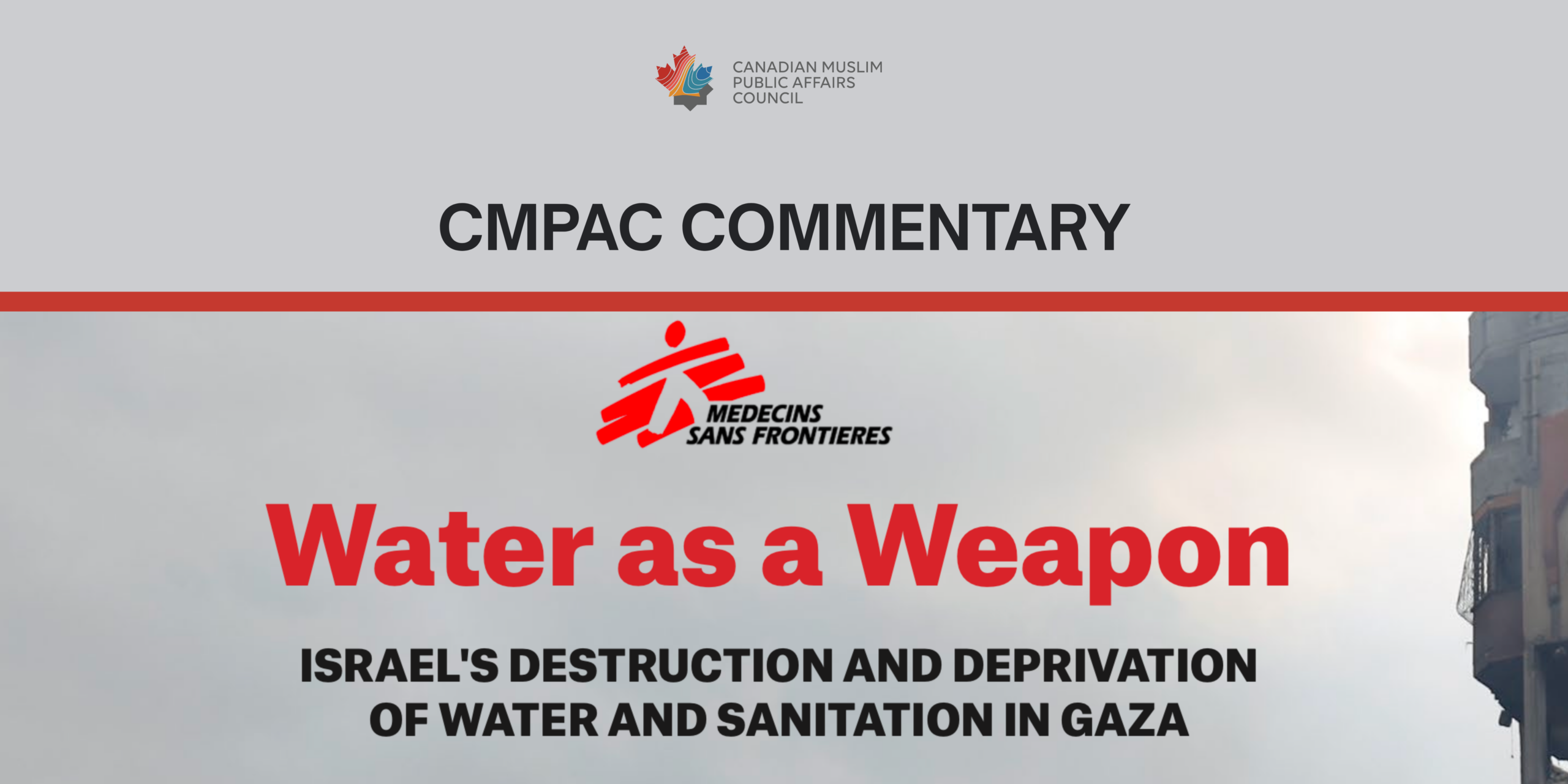
The report Water as a Weapon: Israel’s Destruction and Deprivation of Water and Sanitation in Gaza by Medecins Sans Frontiers (MSF) provides a detailed and evidence-based account of the systematic denial of access to water, sanitation, and hygiene (WASH) services in Gaza. Drawing on operational data, medical evidence, and firsthand testimonies the report concludes that the deprivation of these essential services is not incidental to armed conflict, but rather the result of deliberate policies and actions by Israeli authorities.
At its core, the report advances a critical legal and humanitarian claim: that the denial of water, sanitation, and hygiene (WASH) access has been “weaponised”, producing “destructive and inhumane living conditions” for Gaza’s 2.1 million residents. This framing is significant. It situates water deprivation not as collateral damage, but as a method of warfare with foreseeable and severe consequences for civilian survival making it an integral part of Israel’s genocide
1. The Construction of Water Scarcity
A central finding of the report is that water scarcity in Gaza is engineered rather than incidental. Palestinians face what MSF explicitly terms “engineered water scarcity,” where supply is consistently insufficient to meet even minimum needs. Despite large-scale humanitarian intervention including millions of litres of water distributed daily access remains severely constrained, with distributions frequently running dry before demand is met.
The report identifies three primary mechanisms through which this deprivation is produced:
- Destruction of infrastructure: Approximately 90% of WASH infrastructure, including desalination plants, pipelines, and sewage systems has been damaged or destroyed.
- Restrictions on access and movement: Displacement orders and territorial restrictions have rendered large portions of Gaza inaccessible, impeding both civilians and humanitarian actors.
- Obstruction of supply chains: Essential materials, including fuel, chlorine, and equipment necessary for water treatment and distribution, are routinely blocked or delayed.
These mechanisms operate cumulatively. The report emphasizes that the deprivation of WASH services is “systematic and cumulative,” forming part of a broader pattern of denial and delay. The resulting conditions marked by water scarcity, collapsed sanitation systems, and lack of hygiene supplies are described as “incompatible with human dignity and survival.”
2 – Human Impact: Health, Dignity, and Survival
The report provides extensive documentation of the human consequences of WASH deprivation, demonstrating that the denial of water functions as a multiplier of harm across multiple domains.
- Health Impacts: The collapse of water and sanitation systems has led to a sharp increase in preventable diseases. Nearly one in four individuals surveyed reported diarrhoeal illness within a one-month period, with children disproportionately affected. Skin infections, respiratory illnesses, and malnutrition are also widespread, driven by the inability to maintain basic hygiene.
The report underscores the cyclical relationship between water deprivation and health deterioration: lack of clean water leads to disease, which in turn exacerbates vulnerability to further illness and malnutrition.
- Dignity and Living Condition Beyond physical health, the report highlights profound impacts on human dignity. Palestinians are forced to rely on makeshift latrines, often shared among multiple families, with little privacy or sanitation. Women, in particular, face acute challenges related to menstrual and postnatal hygiene, exacerbating both health risks.
The inability to maintain personal hygiene is repeatedly described as a source of psychological distress, undermining individual and collective well-being.
- Safety Risks Accessing water itself has become hazardous. Civilians including children must travel long distances and gather in crowded conditions to collect water, exposing them to physical danger and violence.
Taken together, these impacts illustrate how the denial of water extends beyond deprivation to produce a comprehensive environment of harm, affecting health, safety, and dignity simultaneously.
3. Legal Characterization: ‘Collective Punishment’ and the ‘Conditions of Life’
The report explicitly situates these findings within the framework of international humanitarian law (IHL). It characterizes the deprivation of WASH services as a form of collective punishment, prohibited under IHL.
Importantly, the report goes further by framing these actions as part of the “deliberate infliction of destructive and inhumane conditions of life” on the Palestinian population. This language aligns with the legal threshold to genocide articulated in the Genocide Convention concerning the creation of conditions of life calculated to bring about physical destruction making the denial of water an integral part of Israel’s genocide
Key Recommendations and Calls to Action
The report concludes with a set of urgent recommendations directed at both Israeli authorities and the international community.
To Israeli Authorities:
- Immediately end restrictions on humanitarian access within and to Gaza;
- Cease obstruction of WASH supplies and infrastructure repair;
- Respect and protect civilian infrastructure and humanitarian personnel;
- End forced displacement of Palestinians.
To UN Member States:
- Uphold international law using available economic, legal, and diplomatic measures;
- Ensure the restoration and protection of WASH access;
- Demand unhindered humanitarian assistance at scale;
- Provide sustained funding for both immediate relief and long-term reconstruction.
Implications for Canada: CMPAC’s Policy Recommendations
The findings of this report have direct legal implications for Canada. As a UN Member State and a party to key international legal instruments, Canada is among the “Third States” referenced in the report as having a responsibility to use “all forms of available economic, security and legal leverage” to ensure compliance with international law.
Accordingly, CMPAC urges the Canada government
- Publicly recognize and respond to the intentional systematic denial of WASH services as documented in the report;
- Support international accountability mechanisms, including investigations into violations of international humanitarian law;
- Ensure that Canadian policies do not contribute to or enable such violations, including through trade, military cooperation, or diplomatic positioning;
- Advocate for and facilitate humanitarian access, including funding and political support for WASH interventions at scale.
These recommendations are framed not as discretionary, but as obligations grounded in existing international legal frameworks. Failure to take such measures risks undermining Canada’s stated commitment to a rules-based international order and the protection of civilian populations.
Conclusion
MSF’s report provides a comprehensive and evidence-driven account of how water deprivation in Gaza has been transformed into a mechanism of Genocide. Its findings demonstrate that the denial of WASH services is systematic and policy-driven.
By situating these practices within established legal frameworks, the report not only documents a humanitarian crisis but also raises urgent questions of legal responsibility and international accountability. For Canada and other states, the implications are to act in accordance with international law to ensure that access to water, an indispensable condition of life, is restored and protected.