

Read op-ed here: https://thepointer.com/article/2026-11-01/beyond-the-ballot-what-olivia-chow-and-alvin-tedjo-s-victories-reveal-about-changing-canadian-politics
By Khaled Al-Qazzaz
Khaled Al-Qazzaz, Executive Director of the Canadian Muslim Public Affairs Council, writes that the mayoral victories in Mississauga and Toronto, accompanied by significant increases in voter turnout, raise important questions about shifting electoral dynamics, the growing political influence of diverse communities and the evolving priorities of Canadian voters
He explores how voter mobilization, economic concerns and demands for principled political leadership may be reshaping traditional electoral calculations. Drawing on the outcomes of these two revealing municipal races, broader perspectives are emerging on what these developments could mean for political engagement and future elections across Canada.
The decisive victories of Olivia Chow in Toronto and Alvin Tedjo in Mississauga tell us something important about the changing political landscape in Canada’s largest urban centres.
These were fierce elections, with polls suggesting narrowing margins in Toronto and a three-way race in Mississauga where the lead shifted between candidates.
Yet the results point to something beyond the usual calculations of incumbency, campaign spending, reliance on polls, age, ethnicity and traditional voting blocs.
The results show new influencing factors that are worth considering in future elections in these cities and beyond.
Perhaps the most significant factor that secured the wins in these two races particularly was the ability to activate new segments of voters. In Toronto, there was more than a 15 percent increase in voter participation compared to the 2022 election (from 29.2 percent in 2022 to 45.8 percent in 2026, over 400,000 more voters). Mississauga saw more than a 12 percent increase in voter participation over the same period (21.8 percent in 2022 to 33.9 percent in 2026, over 84,000 more voters).
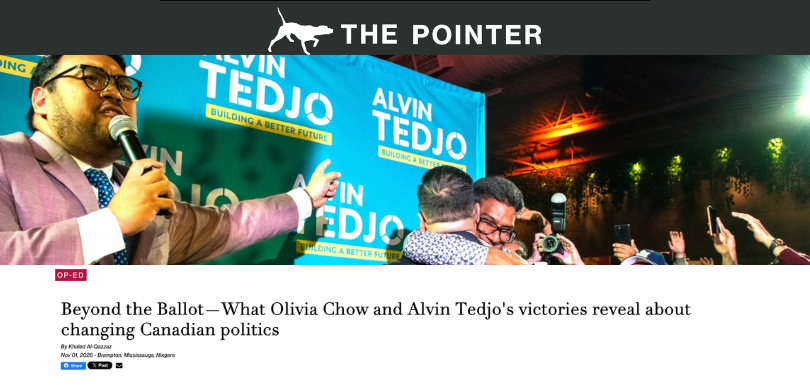
We will wait to see the demographic analysis of the participants in post election polls and surveys. However, it seems there was significant youth participation. There was also significant participation from diverse communities. The crowds during both post-election victory speeches offered anecdotal evidence of significant support from a diverse range of community members who came out for their candidate.
But what motivated these voters to cast a ballot?
Part of the answer lies in the candidates’ ability to connect with the everyday concerns of residents. At a time when affordability and economic uncertainty weigh heavily on families, the messaging of care for the average resident and the most vulnerable resonated more than the care for special interest groups and the elite.
The promise of a food program in schools by Chow, along with the tax relief Tedjo committed to, were well received and showed they care. The candidates themselves simply felt closer and more relatable to the average resident of those big cities than their competitors.
We don’t know if any hidden alliances might have advantaged the two winners, or if they will lead for the people, as promised, once they are sworn in. Tedjo will have to show the endorsement by his city’s police union won’t compromise the connections he made with voters who now expect him to deliver for them. Chow will similarly have to deliver on the protections she has promised for her city.
Yet these elections were not simply about affordability or municipal services. They also reflected a growing expectation that political leadership should be guided by clear principles, including on issues that extend beyond municipal jurisdiction.
Residents looked for moral clarity, unfiltered, non-hesitant positions on humanitarian issues. For many voters, particularly within communities deeply moved by the ongoing genocide in Gaza, Palestine has become a defining test of political integrity.
The position on the genocide in Gaza provided the primary litmus test for communities seeking that moral clarity and principled leadership. They supported the candidates who seemed most sincere with no compromising positions. Many residents almost punished candidates who did not give voice to that moral clarity.
This was particularly evident in the response to endorsements and recommendations issued by organizations aligned with political positions that stand in the way of peace and security for Palestinians.
Rather than necessarily delivering support to their preferred candidates, these interventions might have motivated segments of the electorate to organize and vote in opposition. For these voters, the question was not simply which candidate had the strongest municipal platform, but which candidate demonstrated the moral courage and consistency they expect from political leadership.
In Mississauga, during a mayoral debate, Alvin Tedjo publicly described Israel’s actions in Gaza as genocide and expressed his willingness to sign the Apartheid-Free Communities Pledge.
He will now have to show residents, through his actions, that his words were more than just attempts to secure votes.
The pledge he committed to is not without historical precedent, and it can have significant impact far beyond token gestures.
During the struggle against apartheid in South Africa, municipalities across North America adopted boycotts, divestment measures and public declarations.
In September 1989, the Vancouver City Council passed resolutions to boycott Shell Canada/Royal Dutch/Shell and declared the city a “Shell-Free Zone”. This was done to protest the company’s business ties to South Africa’s apartheid regime.
Other examples demonstrate that municipal governments have long been part of broader human rights movements, reflecting voters’ expectations that political leadership uphold principles of justice beyond local boundaries.
We are beginning to see now with Palestine, what we once saw with South Africa. This is an inflection point in Canadian politics. For years, taking an unequivocal position in support of Palestinian rights was often treated as a political liability. These elections suggest that this calculation may be changing, at least in some of Canada’s most diverse urban communities. For a growing segment of voters, silence or ambiguity on Palestine may now carry a greater political cost than speaking out.
It almost feels like a Canadian version of the Mamdani moment in some of Canada’s biggest cities.
Residents of these cities are looking for different politics, for principled politicians and for broader, more genuine representation in offices that impact their lives.
What happened in Toronto and Mississauga should be understood as more than two municipal victories. It offers an important lesson for political parties and candidates across Canada.
Traditional assumptions about who votes, what motivates them and which positions are politically advantageous cannot be taken for granted. Communities that have too often been treated as passive voting blocs are increasingly organizing, participating and making their expectations heard.
What the campaigns managed to accomplish was inspiring, but the actions that follow in office will put all these promises to test.
The communities that came out and supported will be watching and waiting for real change.
Khaled Al-Qazzaz is Executive Director of the Canadian Muslim Public Affairs Council (CMPAC) which mobilizes communities to fight structural Islamophobia by engaging decision makers and influencing public policy. It is a research-based non-profit organization based in Oakville, Ontario

